
Essential Films Canon
A ranked list of the best films of all-time.
Filter the all-time list:

1. The Magic Rosette

In its day, the moving images in Émile Reynaud’s The Magic Rosette (1878) must have felt more exciting than some current developments in AI technology. Groundbreaking in both form and content, this is one of the few pre-cinematic works of art that possesses a sense of true magic. Released as part of… →

2. The Steeple-Chase
Using only two protagonists, one dressed in red and the other in blue, in The Steeple-Chase (1878), Émile Reynaud exploited optical illusion to create a veritable horse race. The rapid alternation of the jockeys evades the capacity of visual memory to imprint images, producing the mental illusion of… →

3. The Slide
The Slide (1878) can be identified as the first example of applying linear perspective in the history of moving images. Émile Reynaud depicted three boys taking turns on an ice slide before finally jumping over a vault. The setting provides the opportunity to position the human figure deep within th… →

4. The Mechanical Man
Étienne-Jules Marey had a towering impact on the development of cinema both technologically and aesthetically. His earliest work, The Mechanical Man (1885), is a curious and groundbreaking animation for its time. On the one hand, its tricks are meant to serve the technical purpose of reproducing mov… →

5. The Roaster
Among Émile Reynaud’s first series of animated strips, The Roaster (1878) appears as one of the most accomplished works of the cycle. The human movements are mainly limited to the cook bending and pouring the roasting mixture over the rotating spit roast before an open fire. At first glance, there i… →

6. The Aquarium
The Aquarium (1878) is the first title in Émile Reynaud’s first series of praxinoscope strips and may therefore claim the distinction of being the earliest animation exhibited that was purpose-built for motion display. Reynaud’s decision to debut his invention at the Paris Exhibition with this work … →

7. Passage of Venus
Jules Janssen allowed the world to gaze at stellar objects for the first time on film in Passage of Venus (1874). He gave hope that one day images in motion could become part of our quest to understand the world we inhabit. This series of photographs explored the use of moving images for scientific … →

8. The Learned Dogs
The history of animation lies at the heart of cinematic archaeology, and the French inventor Émile Reynaud was a key figure during its experimental years. His invention of the Praxinoscope allowed viewers to perceive moving action generated by the rapid rotation of static images, with significantly … →
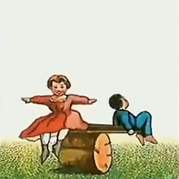
9. The Swing
Émile Reynaud managed to reproduce unfiltered joy in his strip The Swing (1878). The two children are not merely subjects in an animated experiment; they come alive with each movement of the rudimentary apparatus. Their faces burst with laughter, creating an optical illusion that convinces the viewe… →

10. Dzing. Boom. Boom!
Sound emerged as a key technical concern for motion-picture pioneers, largely because it was regarded as a necessary component in reproducing reality. For animators, however, sound functioned primarily as an enhancer of a work’s artistic or entertainment value. In Dzing. Boom. Boom! (1878), Émile Re… →

11. The Lady Charmer
With The Lady Charmer (1878), Émile Reynaud pre-empted Étienne-Jules Marey’s more celebrated chronophotographic gun studies of the 1880s, later collected in Marey’s anthology The Flight of Birds (1890). Avian flight proved capable of delivering visual poetry and thus attracted artists focused on mov… →

12. Feeding the Chickens
A young lady throws corn to chickens that eagerly feast upon it. This simple premise gives rise to one of the more complex scenes animated by Émile Reynaud. Feeding the Chickens (1878) combines the regular motion of the human figure with the irregular activity of two birds, alongside the gradual des… →

13. The Juggler
Of all circus acts, juggling seems best suited to loop animation. In The Juggler (1878), Émile Reynaud enhanced the routine by adding to the juggled knives a multicoloured rotating plate, supported on a pole balanced on the performer’s face. Drawing might have allowed the artist to pursue greater ac… →
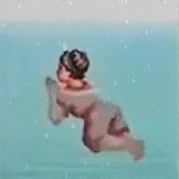
14. The Lady Swimmer
Water ripples calmly around a figure partly submerged in water, performing the breaststroke. In The Lady Swimmer (1878), Émile Reynaud continued his experiments with colour layering to fascinate the viewer with the beauty of animation. The resulting image offers a serene passage into a sense of infi… →

15. The Butterflies
In The Butterflies (1878), Émile Reynaud breathed vivacity into a scene that his contemporaries would have chosen to give a still-life treatment. The insects play a colourful dance around a vibrating flower, thereby celebrating the wonder of living nature. The simplicity of the setting enhanced the … →

16. The Clowns
To conclude his exhibition of the Praxinoscope at the Paris Universal Exposition of 1878, Émile Reynaud selected a particularly engaging subject. The Clowns (1878) presents three circus performers executing somersaults around a horse. The scene is rich in action and unfolds at a rapid pace, inviting… →

17. The Water-mill
Contemporary reviewers credited many of Émile Reynaud’s works as suitable for use as educational material in teaching younger audiences about many aspects of everyday life. The Water-mill (1878) fits these criteria particularly well by depicting a young man manually manoeuvring the eponymous machine… →
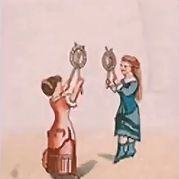
18. The Game of Graces
Games come in and out of fashion. We learn of those that have perished through archaeological remains, whether written or painted. The Game of Graces (1878) is a rare animation contemporary with the heyday of the eponymous game, both now relics in their own right. Émile Reynaud offered a snippet of … →

19. The Tight-rope Dance
The Tight-rope Dance (1878) is a delicate work, reminding us that Émile Reynaud’s animation experiments are a genuine delight. Included in his first series of strips, it features a young female acrobat, dressed in a pink costume, dancing gracefully on a tightrope. The geometrical lines of the compos… →

20. The Trapeze
Émile Reynaud’s Praxinoscope strips are not only experiments in animation but also historical artefacts that showcase forms of popular entertainment from one and a half centuries ago. The Trapeze (1878) may appear antiquated in its subject matter today; in 1878, however, the apparatus was a modern i… →

21. The Two Mischievous Girls
Since the emergence of the internet, videos featuring cats have become synonymous with viral culture. If we attempt to trace their earliest appearance in the history of film, a case can be made for Émile Reynaud’s proto-animation strip The Two Mischievous Girls (1878). The focus on the two children … →

22. The Skipping-Rope
The sensation of infinite motion created by Émile Reynaud’s praxinoscope is best exemplified in The Skipping-Rope (1878), a work ultimately designed to promote an invention that dared to make static pictures move at lifelike speed. This rudimentary sequence strips animation down to its bare bones by… →

23. The Smoker
A man is smoking his pipe whilst his dog seeks his attention. In The Smoker (1878), the movement is limited to the floating smoke and the animal’s barking and wagging its tail. This is another of Émile Reynaud’s animations in which ordinary scenes are constructed to evoke a resemblance to real life,… →
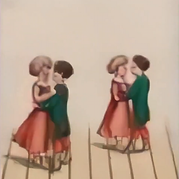
24. The Little Waltzers
The Little Waltzers (1878) is the most crowded of the animation strips in Émile Reynaud’s early oeuvre. It features two young couples performing the waltz, moving in a circle at a three-step pace. The routine requires a specific rhythm, which would have been difficult to achieve using the Praxinosco… →

25. The Musician Monkey
Émile Reynaud’s animated work predates the successes of moving photography. His drawings were brought to life through the praxinoscope. One of these works from his second series of strips is The Musician Monkey (1878). Charming yet simultaneously unsettling in its visuals, this proto-animation harks… →