
Essential Films Canon
A ranked list of the best films of all-time.
Filter the all-time list:

1. Sallie Gardner at a Gallop

Eadweard Muybridge’s Sallie Gardner at a Gallop (1878) invites repeated viewing, much as the zoopraxiscope intended. A seminal work in the history of cinema, this early example of chronophotography demonstrated that moving images were not merely a technical achievement but, more importantly, a desir… →

2. The Kiss
In the search for the earliest moving images of a kiss, we stumble upon Eadweard Muybridge’s The Kiss (1882). Two nude women meet, shake hands and share a loving kiss – imprinting for posterity a moment of homosexual intimacy more often than not torn from the pages of history. Cinema, unlike paintin… →

3. The Magic Rosette
In its day, the moving images in Émile Reynaud’s The Magic Rosette (1878) must have felt more exciting than some current developments in AI technology. Groundbreaking in both form and content, this is one of the few pre-cinematic works of art that possesses a sense of true magic. Released as part of… →

4. Athlete Swinging a Pick
Eadweard Muybridge stripped to his bare skin in Athlete Swinging a Pick (1881) in order to show the full force achievable through human movement. This pose echoes the art of classical Greece, where the naked human body is celebrated for its architecture. It is as if Muybridge saw himself as a Promet… →
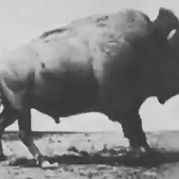
5. Buffalo Running
Eadweard Muybridge made Buffalo Running (1883) over one hundred and forty years ago, yet its importance lasts to this day as the first nature documentary. A precursor to his seminal Animal Locomotion series, this short proto-film establishes a foundational framework for the director’s style. The pre… →

6. The Steeple-Chase
Using only two protagonists, one dressed in red and the other in blue, in The Steeple-Chase (1878), Émile Reynaud exploited optical illusion to create a veritable horse race. The rapid alternation of the jockeys evades the capacity of visual memory to imprint images, producing the mental illusion of… →

7. Athlete Walking 1
Two men walk step by step in Eadweard Muybridge’s Athlete Walking 1 (1881). Their pace evokes the determination of two individuals intending to make history through the most ordinary of gestures. This chronophotographic study is clearly aimed less at scientific exploration and more at artistic perfo… →

8. The Slide
The Slide (1878) can be identified as the first example of applying linear perspective in the history of moving images. Émile Reynaud depicted three boys taking turns on an ice slide before finally jumping over a vault. The setting provides the opportunity to position the human figure deep within th… →
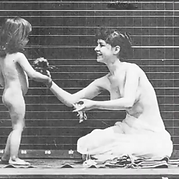
9. Child Bringing Bouquet to Woman
Eadweard Muybridge must have been far more interested in artistic representation than in science when producing Child Bringing Bouquet to Woman (1887). There is ample movement that could serve the study of locomotion, but the emotional warmth of this sequence suggests a rare attempt at narrative bui… →

10. The 1882 Transit of Venus
Given the extraordinary space images we have grown used to seeing today, watching The 1882 Transit of Venus (1882), the telescopic chronophotographic work by David Peck Todd, is a remarkable experience, pointing to the invaluable role photography and film have played in astronomy. When Janssen exper… →

11. The Mechanical Man
Étienne-Jules Marey had a towering impact on the development of cinema both technologically and aesthetically. His earliest work, The Mechanical Man (1885), is a curious and groundbreaking animation for its time. On the one hand, its tricks are meant to serve the technical purpose of reproducing mov… →

12. Athletes Boxing
Boxing was probably the most popular sport to gain exposure through motion pictures in the nineteenth century. In Eadweard Muybridge’s early chronophotographic output we also find Athletes Boxing (1881), a vivacious encounter between two pugilists in combat. Prior to the reincarnation of the modern … →

13. The Roaster
Among Émile Reynaud’s first series of animated strips, The Roaster (1878) appears as one of the most accomplished works of the cycle. The human movements are mainly limited to the cook bending and pouring the roasting mixture over the rotating spit roast before an open fire. At first glance, there i… →

14. Athlete Running 2
At fifty years old, Eadweard Muybridge sported an athletic physique, and it is therefore unsurprising that he featured in many of his own photographic studies. Athlete Running 2 (1881) presents a bearded gentleman sprinting at full speed, lending his body to the study of human locomotion. The images… →

15. The Aquarium
The Aquarium (1878) is the first title in Émile Reynaud’s first series of praxinoscope strips and may therefore claim the distinction of being the earliest animation exhibited that was purpose-built for motion display. Reynaud’s decision to debut his invention at the Paris Exhibition with this work … →

16. Passage of Venus
Jules Janssen allowed the world to gaze at stellar objects for the first time on film in Passage of Venus (1874). He gave hope that one day images in motion could become part of our quest to understand the world we inhabit. This series of photographs explored the use of moving images for scientific … →

17. Woman Throwing Baseball
Woman Throwing Baseball (1887) is a collection of photographs depicting women repeating the action of kneeling to pick up a baseball and then throwing it high into the air. Featuring multiple female subjects of diverse ages and physiques, and captured from various angles, this study takes Eadweard M… →

18. The Learned Dogs
The history of animation lies at the heart of cinematic archaeology, and the French inventor Émile Reynaud was a key figure during its experimental years. His invention of the Praxinoscope allowed viewers to perceive moving action generated by the rapid rotation of static images, with significantly … →
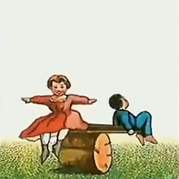
19. The Swing
Émile Reynaud managed to reproduce unfiltered joy in his strip The Swing (1878). The two children are not merely subjects in an animated experiment; they come alive with each movement of the rudimentary apparatus. Their faces burst with laughter, creating an optical illusion that convinces the viewe… →

20. Athlete Running High Leap
The sportsman in Athlete Running High Leap (1881) executes a rather impressive leap over a hurdle. This routine seems most suitable for effectively utilising the full track laid out by Eadweard Muybridge at Palo Alto Stock Farm. Given the speed of the action and the shifting point of view, the camer… →

21. Dzing. Boom. Boom!
Sound emerged as a key technical concern for motion-picture pioneers, largely because it was regarded as a necessary component in reproducing reality. For animators, however, sound functioned primarily as an enhancer of a work’s artistic or entertainment value. In Dzing. Boom. Boom! (1878), Émile Re… →

22. The Lady Charmer
With The Lady Charmer (1878), Émile Reynaud pre-empted Étienne-Jules Marey’s more celebrated chronophotographic gun studies of the 1880s, later collected in Marey’s anthology The Flight of Birds (1890). Avian flight proved capable of delivering visual poetry and thus attracted artists focused on mov… →

23. Athlete Back Summersault 1
Eadweard Muybridge’s early studies of locomotion will always impress with their ambition. At a time when photographs required longer exposure times, capturing rapid movement such as that shown in Athlete Back Summersault 1 (1881) was a technological feat. What it lacks in clarity, this sequence of p… →

24. Feeding the Chickens
A young lady throws corn to chickens that eagerly feast upon it. This simple premise gives rise to one of the more complex scenes animated by Émile Reynaud. Feeding the Chickens (1878) combines the regular motion of the human figure with the irregular activity of two birds, alongside the gradual des… →

25. The Juggler
Of all circus acts, juggling seems best suited to loop animation. In The Juggler (1878), Émile Reynaud enhanced the routine by adding to the juggled knives a multicoloured rotating plate, supported on a pole balanced on the performer’s face. Drawing might have allowed the artist to pursue greater ac… →