
Essential Films Canon
A ranked list of the best films of all-time.
Filter the all-time list:

1. Sallie Gardner at a Gallop

Eadweard Muybridge’s Sallie Gardner at a Gallop (1878) invites repeated viewing, much as the zoopraxiscope intended. A seminal work in the history of cinema, this early example of chronophotography demonstrated that moving images were not merely a technical achievement but, more importantly, a desir… →

2. The Kiss
In the search for the earliest moving images of a kiss, we stumble upon Eadweard Muybridge’s The Kiss (1882). Two nude women meet, shake hands and share a loving kiss – imprinting for posterity a moment of homosexual intimacy more often than not torn from the pages of history. Cinema, unlike paintin… →

3. Athlete Swinging a Pick
Eadweard Muybridge stripped to his bare skin in Athlete Swinging a Pick (1881) in order to show the full force achievable through human movement. This pose echoes the art of classical Greece, where the naked human body is celebrated for its architecture. It is as if Muybridge saw himself as a Promet… →
4. Buffalo Running
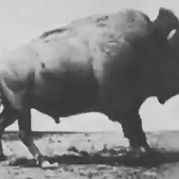
Eadweard Muybridge made Buffalo Running (1883) over one hundred and forty years ago, yet its importance lasts to this day as the first nature documentary. A precursor to his seminal Animal Locomotion series, this short proto-film establishes a foundational framework for the director’s style. The pre… →

5. Athlete Walking 1
Two men walk step by step in Eadweard Muybridge’s Athlete Walking 1 (1881). Their pace evokes the determination of two individuals intending to make history through the most ordinary of gestures. This chronophotographic study is clearly aimed less at scientific exploration and more at artistic perfo… →
6. Child Bringing Bouquet to Woman
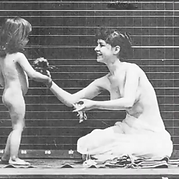
Eadweard Muybridge must have been far more interested in artistic representation than in science when producing Child Bringing Bouquet to Woman (1887). There is ample movement that could serve the study of locomotion, but the emotional warmth of this sequence suggests a rare attempt at narrative bui… →

7. The 1882 Transit of Venus
Given the extraordinary space images we have grown used to seeing today, watching The 1882 Transit of Venus (1882), the telescopic chronophotographic work by David Peck Todd, is a remarkable experience, pointing to the invaluable role photography and film have played in astronomy. When Janssen exper… →

8. Athletes Boxing
Boxing was probably the most popular sport to gain exposure through motion pictures in the nineteenth century. In Eadweard Muybridge’s early chronophotographic output we also find Athletes Boxing (1881), a vivacious encounter between two pugilists in combat. Prior to the reincarnation of the modern … →

9. Athlete Running 2
At fifty years old, Eadweard Muybridge sported an athletic physique, and it is therefore unsurprising that he featured in many of his own photographic studies. Athlete Running 2 (1881) presents a bearded gentleman sprinting at full speed, lending his body to the study of human locomotion. The images… →

10. Woman Throwing Baseball
Woman Throwing Baseball (1887) is a collection of photographs depicting women repeating the action of kneeling to pick up a baseball and then throwing it high into the air. Featuring multiple female subjects of diverse ages and physiques, and captured from various angles, this study takes Eadweard M… →

11. Athlete Running High Leap
The sportsman in Athlete Running High Leap (1881) executes a rather impressive leap over a hurdle. This routine seems most suitable for effectively utilising the full track laid out by Eadweard Muybridge at Palo Alto Stock Farm. Given the speed of the action and the shifting point of view, the camer… →

12. Athlete Back Summersault 1
Eadweard Muybridge’s early studies of locomotion will always impress with their ambition. At a time when photographs required longer exposure times, capturing rapid movement such as that shown in Athlete Back Summersault 1 (1881) was a technological feat. What it lacks in clarity, this sequence of p… →

13. Skeleton of Horse
Eadweard Muybridge's Skeleton of Horse (1881) is a striking reminder of the painstaking efforts of scientists working in motion photography in the nineteenth century. This first attempt at stop-motion animation is remarkable for its sharpness. By the 1880s, Muybridge had perfected his technology to … →

14. Woman Walking Downstairs
Eadweard Muybridge’s fascination with the nude resembles the concern classical artists had with the body. His Woman Walking Downstairs (1887) takes the simplicity of the act to celebrate human beauty within a new art-form. Conversely, a quarter of a century later, Marcel Duchamp pushed the boundarie… →

15. Man Riding Jumping Horse
Horse gaits never ceased to feature as subject matter in Eadweard Muybridge’s output since his initial successes in California in 1878. Produced within a decade, Man Riding Jumping Horse (1887) was shot in Philadelphia, featuring Daisy passing over a hurdle. The sequence of photographs still demonst… →

16. Athlete Running 4
Of all the chronophotographic works featuring runners first presented by Eadweard Muybridge in 1881, Athlete Running 4 (1881) presents the most athletic figure. With an impressive physique, the performer uses his full bodily strength to propel himself forward with every stride. His motion resembles … →

17. Athlete Running 3
There is a striking resemblance between the man in Athlete Running 3 (1881) and the Artemision Bronze of Zeus, making it difficult not to link Eadweard Muybridge’s oeuvre with the art of Ancient Greece. The aesthetic produced by the silhouette in this chronophotographic work alludes strongly to that… →

18. Woman Hopping on One Foot
Part of Eadweard Muybridge’s studies on locomotion, Woman Hopping on One Foot (1887) clearly demonstrates the scientific purpose of his work. Shot from the front, back, and side, the woman is seen hopping on her left foot, her body tilting slightly, while her arms carefully maintain balance with eac… →

19. Athletes Wrestling
The sequence of photographs Athletes Wrestling (1881) by Eadweard Muybridge presents two fighters locked in a Greco-Roman bout. Through his association with the Olympic Club of San Francisco, Muybridge had access to numerous volunteers who performed for his cameras. The wrestlers ignore the setting … →

20. Boys Playing Leapfrog: Side View
Boys Playing Leapfrog: Side View (1887) was intended as a scientific study of human locomotion, following Muybridge’s Athletes series at Palo Alto Stock Farm. These photographs from Philadelphia, taken a few years later, exhibit significantly improved visual quality, allowing close observation of in… →

21. Athletes Fencing
Given that fencing was first regularised in 1880 in London, Muybridge’s sequence of photographs Athletes Fencing (1881) offers direct evidence of the growing popularity of the sport in its early days. The moving images could have served as educational material for those seeking to understand the new… →

22. Athlete Back Summersault 2
The human body inevitably became Eadweard Muybridge's principal focus of study, largely because it is capable of executing varied actions as required. This precision of movement is clearly evident in Athlete Back Summersault 2 (1881), in which a young man performs a back flip with notable ease. This… →

23. Athlete Running 6
Athlete Running 6 (1881) reuses the same format as Athlete Running 4 (1881), except that the main protagonist here is a leaner, and possibly younger, sprinter. From a technical standpoint, this series of photographs suffers from increased contrast, leaving the male body to appear more as a silhouett… →

24. Cockatoo Flying
Because parrots are swift fliers, Eadweard Muybridge’s ambition to record them using chronophotography invites admiration. Cockatoo Flying (1887) is an early example of a bird in flight. For the first time in history, scientists gained the opportunity to analyse in detail the movement of avian wings… →

25. Athlete Walking 2
Eadweard Muybridge’s studies of human locomotion filmed at Palo Alto Stock Farm include the most fundamental actions. In Athlete Walking 2 (1881), the subject performs the most basic of human activities, allowing us to observe the all-too-familiar movements of musculature captured with notable succe… →